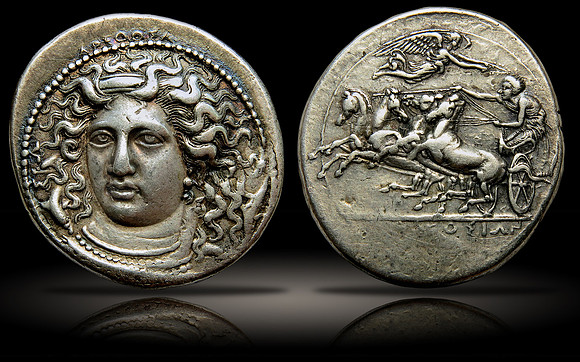
Arethusa the Savior, Signed by Kimon
Undoubtedly among the most influential coinages of ancient Greece, this particular die pairing stands as one of Kimon’s masterpieces. The obverse features a captivating portrait of the nymph Arethusa, whose calm, composed expression contrasts with the vivid energy of the surrounding elements - and with the vigorous scene depicted on the reverse. Her hair streams outward in animated waves, enhancing rather than distracting from her beauty, as its backward flow leaves her face unobscured.
Intertwined with her flowing locks are four dolphins: one fully depicted on the right, another nearly so on the left, and the remaining two visible only by their faces, each peeking in from opposite sides. Kimon masterfully gives the dolphins with a sense of playfulness - a hallmark of their natural charm and a testament to his ability to render lifelike movement. Even the dotted border serves a purpose, subtly containing the visual force of Arethusa’s image without limiting its impact.
Perhaps most impressive is Kimon’s integration of three inscriptions into the design, each woven seamlessly into the composition. His signature appears on the ampyx holding back Arethusa’s hair; her name is elegantly placed above the border; and an abbreviation for “savior” is so ingeniously hidden among the dolphins and strands of hair on the left that it remained undiscovered until recent scholarship brought it to light.
The reverse is no less dynamic. It shows a quadriga in high motion, viewed at a slight angle that demonstrates Kimon’s grasp of perspective. The scene captures a precise instant just after the meta, as the charioteer reins in his team - horses rearing and heads tossing in chaotic reaction. The driver’s control reflects an unexpected yet skillful maneuver, vital to securing victory, which is symbolized by Nike crowning him. The reverse border, a thin unbroken line, allows the intensity of the moment to dominate, with the lead horse’s hooves even breaking through it - further emphasizing the force and immediacy of the action.
Together, the obverse image of “Arethusa the Savior” and the triumphant charioteer on the reverse, combined with the exquisite artistry of the dies, mark this coinage as commemorative in nature. It has been linked to significant historical moments, especially the Athenian defeat at Syracuse in 413 B.C., or more plausibly, the fortunate survival of the Syracusans during the Carthaginian invasion of 406–405 B.C.
Ex. Sotheby´s/NFA, auction 26.10.1993, lot 12 (cover coin); Ex. Numismatica Ars Classica, auction 54, 24.3.2010, lot 56; Ex. NGSA, auction 12, 18-19.11.2019, lot 112