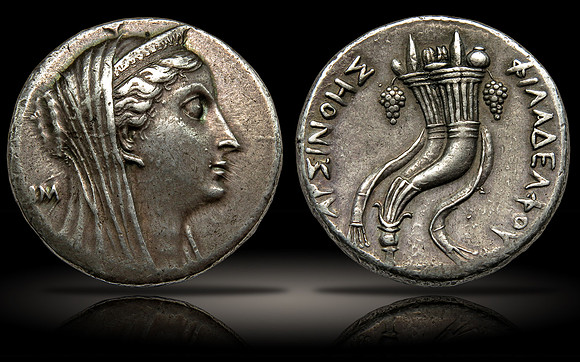
Arsinoe Dekadrachm
Arsinoe II, daughter of Ptolemy I and Berenike I, was born in 316 BC and had a tumultuous early life. At the age of 15, she was married to Lysimachos of Thrace, and later to her half-brother, the cruel Ptolemy Keraunos. After conspiring against him, she fled to Egypt around 280 BC, seeking refuge with her younger full brother, Ptolemy II. Arsinoe's intelligence, charm, and beauty captivated Ptolemy, and after orchestrating the removal of his previous wife on charges of treason, Arsinoe married him around 276 BC. While sibling marriages were common in Egyptian royalty, the union was unprecedented among Greeks, reinforcing the notion of rulers being worshipped as divine. Arsinoe became a capable queen and co-ruler, particularly in the domain of foreign affairs. She died in 270 or 268 BC and was immediately deified, marking her legacy with widespread coinage featuring her veiled portrait and symbols of her divinity.
Following Arsinoe II's death, her cult, Thea Philadelphus ("brother-loving goddess"), was established, distinguishing it from the pre-existing cult of Theoi Adelphoi. Her honorary coinage began with silver decadrachms issued shortly after her death, followed by gold coins beginning around 261/0 BC. The largest of these coins was an octodrachm, worth 100 silver drachms, and remained in circulation for over 150 years. Her coin portrait emphasized her royal lineage, featuring a jeweled diadem, a lotus sceptre, and a ram's horn symbolizing her divinity. The reverse of the coin celebrated her sibling relationship with Ptolemy II, inscribed with "APΣINOHΣ ΦIΛAΔEΛΦOY" ("[coin] of Arsinoe, brother-lover") and accompanied by a double cornucopia, a symbol of bounty and fertility thought to be a personal emblem of Arsinoe II.
A significant coin issued in honor of Arsinoe II was a silver decadrachm, rarer than the gold octodrachm, which commemorated her posthumous deification. This coin features the double cornucopia as a symbol of renewal, fertility, and the Ptolemaic dynasty's role as a source of abundance. The cornucopia may also evoke associations with Isis-Aphrodite, further reinforcing Arsinoe’s divine status. This coinage illustrates not only her importance in the Ptolemaic dynasty but also the broader cultural and religious significance of her deification, linking her to the dynastic and divine ideals of the period.
PTOLEMAIC KINGS of EGYPT. Arsinoe II Philadelphos. Died 270/268 BC. AR Dekadrachm (33mm, 35.65 g, 12h). Alexandreia mint. Struck under Ptolemy II, circa 253/2-250/49 BC. Head right, with ram's horn, veiled and wearing stephane; lotus-tipped scepter in background, MM to left / APΣINOHΣ ΦIΛAΔEΛΦOY, double cornucopia with grape bunches hanging at sides, bound with fillet. CPE 354 (Ptolemy II); Svoronos 947; Troxell, Arsinoe, Group 3, p. 44 and pl. 7, 7 = SNG Lockett 3415 (same obv. die); SNG Berry 1483 (this coin); SNG Copenhagen –; BMC 26; Boston MFA –; Hermitage Sale II 1583; Ward 889 = Ward Sale 740 (same obv. die).
From the collection of a Northern California Gentleman. Ex Numismatic Fine Arts XVIII (31 March 1987), lot 261; Burton Y. Berry Collection (published in 1961).