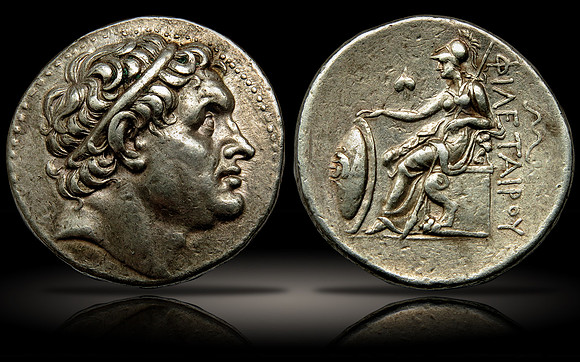
Philetairos
Philetairos began his career serving under Antigonos Monophthalmos, but after the Battle of Ipsos in 301 BC where Antigonos was killed, he shifted his allegiance to Lysimachos, who entrusted him with command of the fortress of Pergamon, and a treasury of nine thousand talents of silver (234 metric tonnes). Philetairos served Lysimachos until 282 BC, when perhaps because of conflicts involving the court intrigues of Arsinoe, Lysimachos' third wife, Philetairos deserted Lysimachos, offering himself and the important fortress of Pergamon, along with its treasury to Seleukos, who subsequently defeated and killed Lysimachos at the Battle of Korupedion in 281 BC. Seleukos himself was murdered by Ptolemy Keraunos, a brother of Arsinoe, a few months later at Lysimacheia.
After the death of Seleukos, though he and Pergamon remained nominally under Seleukid dominion, Philetairos had considerable autonomy and with the help of his considerable wealth was able to increase his power and influence beyond Pergamon. His first coinage was struck under the reign of Antiochos I, the son of Seleukos, and though it proclaims his loyalty to Seleukos, the presence of his name upon the reverse must have inevitably raised suspicions about his ambitions. Nevertheless, Philetairos never went so far as to proclaim himself king, and remained loyal to the Seleukids until his death in 263.
Having no children of his own, Philetairos passed the rule of Pergamon to his nephew Eumenes, who almost immediately revolted against Antiochos, defeating the Seleukid king near Sardes in 261. Euemenes was thus able to free Pergamon, and greatly increased the territory under his control. In his new possessions, he established garrison posts in the north at the foot of Mount Ida called Philetaireia after his adoptive father, and in the east, northeast of Thyatira near the sources of the river Lykos, called Attaleia after his grandfather, and he extended his control south of the river Caïcus to the Gulf of Kyme as well. Demonstrating his independence, he began to strike coins as his predecessor had done, only now the obverse portrait was that of his uncle and adoptive father Philetairos.
As guardian of the treasure of Lysimachus in the castle of Pergamon, Philetairos changed sides shortly before the Battle of Kouropedion, which brought his master's downfall, and declared his loyalty to Seleucus. However, the first coin minted by the Pergamenian shows a clear claim to independence. Although he embossed the image of the Seleucid on the front, he made his independence clear by mentioning his own name on the reverse. Philetairos' loyalty seems to have been more tied to the person of Seleucus I, whose image he continued to put on his coins after his death, and less to the royal house of the Seleucids, from whose influence he gradually broke away.
When Lysimachos established the mint of Pergamon, he entrusted its treasury to the eunuch Philetairos. Philetairos changed his allegiance to Seleukos I, probably shortly before the Battle of Korupedion in 281 BC, where Seleukos defeated Lysimachos. Although Seleukos was assassinated the following year, Philetairos struck a series of Alexander-type issues in the name of Seleukos. Philetairos continued to acknowledge Seleukid primacy for some time, but soon struck a coinage in his own name. This coinage featured Athena Nikephoros on the reverse, similar to the reverses of Lysimachos. Perhaps because this move might have been viewed as a threat by his Seleukid overlord, the obverse of the first issues of these coins featured the portrait of Seleukos I. This coinage is generally assigned to the aftermath of Antiochos I's victory over the Galatians, circa 269/8 BC.
Mysia, Kings of Pergamon, Philetairos (282-263 BC), tetradrachm, after 274 BC, diademed head of Seleukos I of Syria, rev., ΦΙΛΕΤΑΙΡΟΥ, Athena seated left, resting right hand on round shield before her and holding transverse spear in left hand, her elbow resting on a sphinx support; above, ivy-leaf; on far right, bow, 17.05g, die axis 12.00 (Wealth of the Ancient World 104, this piece; Newell, "The Pergamene Mint under Philetaerus", NNM 76, 14 and pl. 10, 1, same obverse die; BMC 28-29; cf. Kraay-Hirmer 736)
Kimbell Art Museum, Fort Worth, Texas (1983); Virginia Museum of Fine Arts (1983); Detroit Institute of Arts (1984); Dallas Museum of Art (1984); Nelson Bunker Hunt collection, part I, Sotheby's New York, 19 June 1990, lot 105; European Connoisseur collection (formed before 2002).