A Pyrrhic Victory
Pyrrhus of Epirus, one of the most admired Hellenistic kings after Alexander the Great, is best remembered for his ambitious campaigns in Italy and Sicily and for the term Pyrrhic victory, signifying a costly success. In 281 B.C., he led an army of 25,000 men and 20 elephants to support the Greek city of Tarentum against Rome. Though he defeated the Romans at Heraclea (280 B.C.) and Asculum (279 B.C.), his victories came at great cost, severely depleting his forces. His quip after Asculum, “One more such victory, and we are lost,” epitomizes his struggles.
Seeking to expand his influence, Pyrrhus campaigned in Sicily (278–275 B.C.) against the Carthaginians, nearly driving them off the island. However, his extended absence caused unrest in his territories, and he returned to Italy, where he faced another inconclusive battle at Beneventum in 275 B.C. With his forces dwindling, Pyrrhus retreated to Epirus, burdened by financial strain and growing hostility in Magna Graecia.
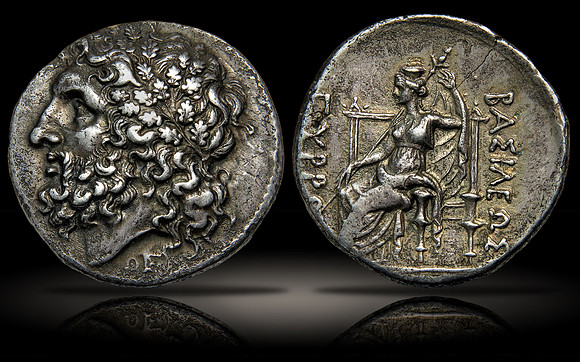
Pyrrhus’ coinage reflects his unique approach to kingship. Unlike other Hellenistic rulers, who often used coinage to glorify their reign, Pyrrhus’ coins honored the gods of Epirus—Zeus Naios and Dione, venerated at the sanctuary of Dodona. His tetradrachms, renowned for their artistry, may have been minted at Locri Epizephyrii to finance his campaigns or pay tribute. Notably, these coins often bore a distinct Epirote character, emphasizing Pyrrhus' cultural and religious ties to his homeland.
Despite his military brilliance, Pyrrhus' campaigns left him overextended. His plundering of the temple of Persephone in Locri, viewed as impiety, brought divine retribution in the form of shipwrecks and misfortune. Seeking to appease the gods, he eventually returned the stolen treasures. Pyrrhus died in 272 B.C. during a street fight in Argos, leaving behind a legacy as a formidable yet ultimately unsuccessful challenger to Rome and Carthage.
Epirus Pyrrhus, 297-272 BC tetradrachm, AG 16.82 g. Obverse: Head of Zeus with oak leaf crown to the left, monogram at the bottom. Reverse: ΒΑΣΙA[ΕΩΣ] ΠΥΡΡΟΥ, Dione seated with scepter, pulls the peplos over his shoulder with his left hand Ref: J. Babelon, Le roi Pyrrhus, ANS Centennial Publication, New York, 1958, p. 61 (this copy mentioned), pl. VII, no 1.
Ex NGSA 4, 11-12-2006, lot 68; ANS Centennial Publication, New York, 1958, p. 61 (this example mentioned), pl. VII, nº 1; Ex Collections Montagu, Sotheby's, Londres 1896, lot 328; Ex Collection Weber n° 301 & Ex Collection Locker Lampson n° 187; Billoin Collection (Rollin et Feuardent, 22 March 1886), lot 425