The Creation of the Alphabet
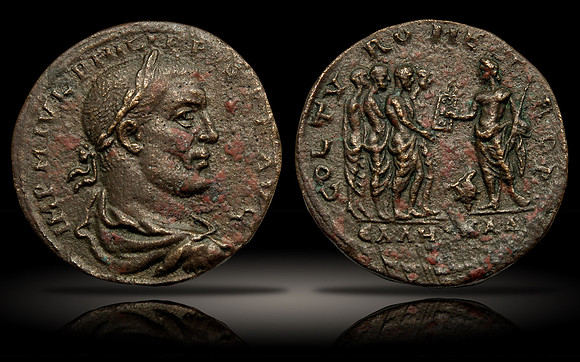
This coin holds immense historical significance as it commemorates a transformative moment in Greek history: the adoption of the Phoenician alphabet. This development marked the Greeks' recovery from the loss of their earlier written languages, Linear A and Linear B, associated with the Minoan and Mycenaean civilizations. The introduction of a written alphabet, complete with vowels, revolutionized Greek culture by enabling the preservation of oral traditions, mythology, and knowledge in a permanent, transmissible form. The written word allowed Greek cultural, intellectual, and scientific achievements—ranging from literature and philosophy to astronomy and medicine—to endure across generations. The coin’s depiction of Cadmus, a figure from Greek and Phoenician mythology, presenting the alphabet to four Greeks, symbolizes this pivotal event.
Historical accounts suggest that the Greeks adopted the Phoenician alphabet around the early 8th century BC, though Herodotus attributes its introduction to Cadmus, a Phoenician prince, as early as 2000 BC. Herodotus (5.58) records that the Phoenicians, led by Cadmus, brought numerous innovations to Greece, chief among them the art of writing. The Greeks initially used the Phoenician characters before adapting them to their own language. This process likely involved gradual modifications rather than a singular cultural hero, but the legend of Cadmus as a bringer of the alphabet reflects the mythological significance attributed to this transition.
The coin itself, a large bronze issue struck at Tyre during the reign of Philip I in the third century AD, illustrates how Tyrians celebrated their cultural contributions within the Graeco-Roman world. Such coins often highlighted mythic events to emphasize Tyre's historical prominence and assert its cultural superiority over rival Phoenician cities like Sidon. The reverse side of this coin showcases Cadmus, clearly identified as a Phoenician prince, passing the alphabet to labeled Hellenes. This imagery not only reinforces Tyre's role in shaping Greek civilization but also underscores the enduring influence of Phoenician culture on the Mediterranean world.
While modern scholarship acknowledges that the Greek alphabet evolved from the Phoenician script over time, the timeline presented by Herodotus is historically problematic. Cadmus, according to Herodotus, lived around 2000 BC, long before the emergence of the Greek alphabet in the late 9th or early 8th century BC and even before the use of Linear B. Despite these chronological discrepancies, the coin captures the pride Tyrians took in their mythological heritage and their connection to the Greek cultural legacy. The Phoenician alphabet, adapted and refined by the Greeks, became the foundation for the literary and intellectual achievements that defined the Hellenized world and influenced the eastern provinces of the Roman Empire.
This extremely rare and highly interesting issue explicitly names the figures and represents the legend as recorded in Herodotus 5.58:
"The Phoenicians who came with Cadmus-amongst whom were the Gephyraei-introduced into Greece, after their settlement in the country, a number of accomplishments, of which the most important was writing, an art till then, I think, unknown to the Greeks. At first they used the same characters as all the other Phoenicians, but as time went on, and they changed their language, they also changed the shape of their letters. At that period most of the Greeks in the neighborhood were Ionians; they were taught these letters by the Phoenicians and adopted them, with a few alterations, for their own use, continuing to refer to them as the Phoenician characters-as was only right, as the Phoenicians had introduced them."
Philip I, 244 – 249; Bronze, Tyre circa 244-249, Æ 30 mm, 18.88 g. IMP M IVL PHILLIP[V]S P F AVG Laureate, draped, and cuirassed bust r. Rev. COL TV – RO ME – T – ROP Cadmus presenting the alphabet to the Hellenes: Cadmus standing l., holding spear in l. hand, with r. hand he presents a rolled papyrus to the first of four Greeks standing r.; murex shell at Cadmus' feet, in exergue, ЄΛΛH and KAΔ. Rouvier 2446 = Babelon, Perses 2281. BMC –. RPC Online unassigned ID 6505 (this coin illustrated).
Ex Triton sale XXIII, 2019, 729. From the Peter Bowe collection.