Personifying Gold, Silver, and Bronze
It is believed that bronze medallions depicting Moneta were distributed as imperial gifts during the Roman New Year celebrations. Originally, Moneta was an epithet of the goddess Juno, whose temple on the Capitoline Hill housed Rome's mint. Over time, Moneta became the personification of the mint and its coinage. While Moneta typically appears alone on late third-century Roman coins, this medallion uniquely features her in triplicate, a design echoing earlier medallions of Emperor Probus. The triadic depiction of Moneta draws a parallel to the Three Graces and harkens back to the Roman Republic, when three magistrates, the Tresviri Aere Argento Auro Flando Feriundo, oversaw the minting of coins in different metals.
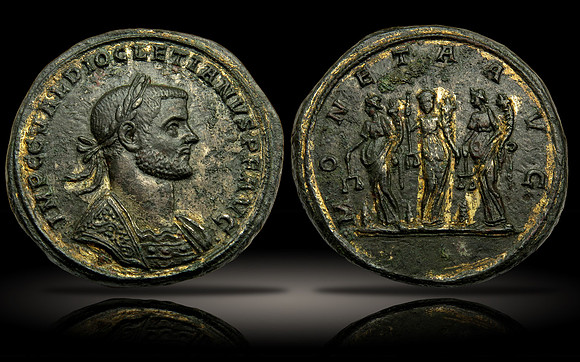
The reverse side of the medallion showcases the "Tres Monetae" motif, typically accompanied by the inscription "MONETA AVG(G)." Each of the three figures is depicted holding a cornucopia and scales while standing beside a pile of coins. The two outer figures hold shorter rods with scales, while the central figure, presumed to represent gold, holds a longer rod, reflecting the higher standard associated with gold's precision in weighing. This symbolism aligns the three Monetae with the coining metals of gold, silver, and copper, emphasizing the role of each in the minting process and the centrality of gold in the imperial economy.
From the late second century onward, the "Tres Monetae" reverse became a popular choice for medallions, often used when no specific commemorative design was required. Despite being produced in significant quantities, these medallions are rare today due to the frequent melting and repurposing of their metal. Typically, base metal medallions were bimetallic, combining golden brass and red copper or bronze, but they were also made in silvered bronze, pure silver, or gold. Precious metal examples are exceedingly rare, with bronze medallions like this one only slightly more common.
Diocletian, 284 – 305 Medallion circa 290, Æ 39.22 g. IMP C C VAL DIOCLETIANVS P F AVG Laureate and cuirassed bust r., wearing decorated imperial mantle. Rev. MONETA AVG The three Monetae standing facing, the outer two with heads l., holding scales and cornucopiae; at their feet, heaps of coins. C 320 var. (draped and cuirassed). Gnecchi –, cf. pl. 124, 8 (draped and cuirassed). Toynbee –. An apparently unrecorded variety. Traces of the original gold gilding still visible.
Ex Hess-Leu 16th April 1964, 345.