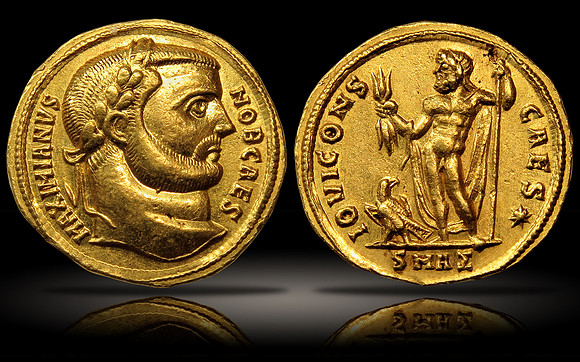
Galerius
Galerius began life as the son of a peasant herdsman. His mother, Romula, was a pagan priestess from the far side of the Danube who fueled his lifelong respect for the "old gods" of Rome and his hatred for Christianity. A large, imposing man, he found a career in the military and rose through the ranks to become Praetorian Prefect under Diocletian. On 1 March AD 293, Galerius was made Caesar of the East. Winning a decisive victory over Persia in AD 296, his influence over Diocletian grew steadily. In AD 302, he induced his senior to launch the Great Persecution - an all-out effort to crush Christianity root and branch.
In AD 305, Diocletian abdicated and Galerius became Augustus of the East. He had already arranged that the new Caesars, Severus II and Maximinus Daza, would be exclusively loyal to him. However, the death of Constantius I the following year launched a chain reaction of upheaval that threw the Tetrarchic system into chaos, and Galerius spent the rest of his reign desperately trying to restore some semblance of order. In AD 310, he fell victim to a wasting disease that left him horribly disfigured and in constant pain. The Christians claimed it was God's vengeance, and Galerius seems to have at least partly believed it, for he ordered the persecution formally ended just five days before he died in May AD 311.
The weight standard of this aureus is indicated by the modified Ξ mark - the numerical equivalent of 60 in the Greek numbering system - thus 1/60th of a pound (approximately 5.46 grams).
Ex. Peus Nachf. 369, Frankfurt am Main 2001, No. 832