Claudius De Britann
In AD 43, Emperor Claudius authorized a military campaign to Britain, led by the distinguished senator Aulus Plautius, following an appeal for support from Verica, the ousted king of the Atrebates. The invasion faced resistance from a coalition of tribes led by Togodumnus and Caratacus, sons of Cunobelinus, the late king of the Catuvellauni. The Romans encountered significant opposition at a river crossing, likely near the Medway, where a two-day battle unfolded. Notable efforts included future Emperor Vespasian’s Legio II Augusta fording the river and an auxiliary unit of Batavians launching a surprise attack. On the second day, Gnaeus Hosidius Geta turned the tide of battle, securing a decisive Roman victory and earning triumphal ornaments for his valor.
Following further engagements, the Britons retreated to the Thames, where Claudius himself joined the campaign with reinforcements, including war elephants and Praetorian Guards, to solidify Roman dominance. Taking command, Claudius led his forces to capture Camulodunum (modern Colchester), the capital of Cunobelinus. His success resulted in numerous tribes capitulating, either by force or diplomacy. For his triumphs in Britain, the Senate awarded Claudius the title “Britannicus” and commissioned two triumphal arches—one in Rome on the Via Flaminia and another in Gaul—to commemorate the conquest.
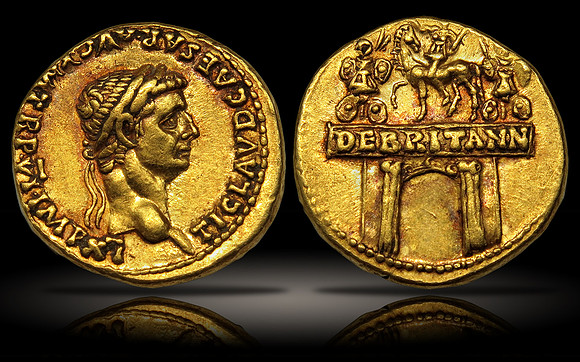
The triumphal Arch of Claudius, depicted on this rare aureus, was a converted structure from the Aqua Virgo aqueduct, located on the Via Flaminia. While the arch no longer exists, fragments of its inscription survive in the Capitoline Museum, and its full text has been reconstructed based on a sister arch in Boulogne-sur-Mer. Coins like this aureus celebrated Claudius' achievements and the successful integration of Britain into the Roman Empire, emphasizing the architectural and symbolic legacy of his rule. The depiction on the coin served as a "blueprint" for the arch before its completion in AD 51.
Claudius’ ascent to power was unexpected, given his physical disabilities and initial exclusion from public life. Elevated by the Praetorian Guard after Caligula's assassination, Claudius emerged as a capable ruler despite his lack of political experience. He initiated significant public works, respected the Senate, and declined many traditional honors. His reign saw accomplishments like the conquest of Britain and infrastructural developments. However, his later years were marked by intrigue, including his possible poisoning by his fourth wife, Agrippina the Younger, to secure the throne for her son, Nero. Claudius’ coinage, including this aureus, reflects both the successes and complexities of his rule, with a refined portrait symbolizing the continuity of the Julio-Claudian dynasty.
Claudius I (AD 41-54). AV aureus (18mm, 7.73 gm, 4h).
Rome, AD 46-47. TI CLAVD CAESAR•AVG•P•M•TR•P•VI•IMP XI, laureate head of Claudius I right / DE BRITANN, legend on architrave of triumphal arch surmounted by equestrian statue left, right hand raised, spear in left; between two trophies. Calicó 349a (Rome or Lugdunum). RIC I 33.
Ex Classical Numismatic Group, private sale (30 July 2005), lot 758328; Sir Arthur Evans Collection (Ars Classica, Auction XVII, 3 October 1934), lot 1251; Bourgey (2 March 1925), lot 124.