Ex. Apostolo Zeno
Apostolo Zeno (1668–1750), a prominent Venetian scholar, poet, and librettist, served as Court Poet and historian to Holy Roman Emperor Charles VI between 1718 and 1729. In addition to writing libretti for composers such as Scarlatti and Vivaldi, Zeno played a significant role in managing the imperial coin collection. A man of broad intellectual pursuits, he co-founded the Accademia degli Animosi in 1691 and Italy's first critical literary journal, Giornale de' letterati d'Italia, in 1710. After retiring to Venice in 1729, Zeno dedicated his remaining years to the study and expansion of his personal coin collection.
Zeno's coin collection, formed primarily during the first half of the 18th century, was regarded as one of the most significant of its time. His numismatic interests were a natural extension of his scholarly endeavors in history and philology, reflecting his deep appreciation for antiquity.
Towards the end of his life, Zeno parted with his collection with a heavy heart: at the end of September 1747 he sold his Museo, as he called all of his coins, to the Augustinian monastery in Sankt Florian (Upper Austria) for 20,000 guilders, far below their actual value. Among the 10,766 coins were mainly Roman, but also Greek, Celtic, Byzantine and Islamic coins, 433 of them in gold.
The purchase by the Abbey ensured its preservation long after his death in 1750. The collection exemplified the intellectual rigor and curiosity of its creator, rivaling even the emperor's holdings in scope and significance.
More than two centuries later, Zeno's collection was sold at auction by Dorotheum in Vienna between 1955 and 1957, marking one of the most important sales of a provenanced numismatic collection in modern times. With its origins tracing back to the late 17th and early 18th centuries, this collection not only provides insight into the collecting practices of the Enlightenment but also represents a critical link in the history of ancient numismatics. The sale underscored Zeno's enduring legacy as a scholar and collector, whose contributions spanned literature, history, and the arts.
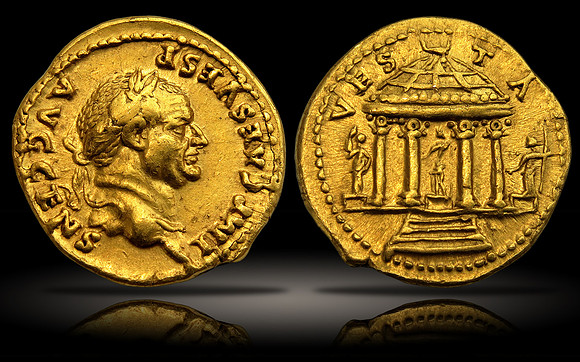
Regarding the coin itself, the Temple of Vesta is one of the most elegant and symbolic architectural types depicted in Roman numismatics. A notable example is the aureus struck during the reign of Domitian, featuring the temple on its reverse. This design is unique among Flavian coinage as it lacks a numismatic predecessor. Originally introduced by Vespasian in 72/73, the Temple of Vesta type appeared exclusively on coins issued in Titus's name, with the exception of one shared issue in 73. The presence of this design on a Domitian aureus is anomalous, as Domitian's precious metal coinage was first issued in 73 and typically featured types specific to him, such as his equestrian aureus. This coin, therefore, represents a rare departure from the structured patterns of Vespasian's coinage.
The historical Temple of Vesta, believed to have originated during the reign of Numa Pompilius, was a sacred site central to Roman religion and statehood. It housed vital relics, including the Palladium, and served as a repository for legal documents and senatorial wills. The temple’s sacred fire, maintained by the Vestal Virgins, was considered essential to the city's fortunes, with its extinction viewed as a dire omen. Despite multiple reconstructions following fires, including Nero’s restoration after the Great Fire of AD 64, the temple's symbolic significance endured. The depiction of Nero's reconstruction on Vespasian's coinage highlights the continuity of this sacred institution, even as it underscores the political narrative of reclaiming Rome for its people after Nero’s excesses.
The inclusion of the Temple of Vesta on Vespasian’s coinage likely reflects his role as Pontifex Maximus and his dedication to reinforcing Rome’s religious and cultural traditions. As the founder of the Flavian dynasty, Vespasian associated himself with the goddess of the hearth, home, and family, emphasizing stability and unity. The irony lies in the contrast between Vespasian’s commemoration of Nero’s temple and his simultaneous construction of the Flavian Amphitheatre on land previously seized for Nero’s Domus Aurea. This act of returning public spaces to the Roman populace symbolized the Flavian dynasty's efforts to restore civic pride and rebuild Rome’s physical and moral fabric.
Architecturally, the Temple of Vesta was consistently circular, a form evocative of early Roman dwellings and symbolic of Vesta's role as protector of the hearth and home. Its domed roof, with an open oculus, allowed light and smoke to escape, preserving the sacred flame within its fully enclosed cella. Ancient sources, including Ovid and Dionysius of Halicarnassus, emphasize the temple’s unique design and its lack of a cult statue, underscoring its distinction from other Roman temples. However, numismatic depictions often include statues, prompting scholars like Philip Hill to suggest these images may represent the Aedicula Vestae on the Palatine Hill, a shrine incorporated into Augustus’s residence. This interpretation highlights the complex interplay between architectural representation, religious symbolism, and imperial propaganda in Roman coinage.
Vespasianus, 69-79. AV-Aureus, 73, Rome; 7.27 g. Head right with laurel wreath//Temple of Vesta between the statues of two goddesses, inside a statue of Vesta. BMC 109; Calicó 691; Coh. 578; RIC² 549.
Ex. P. & P. Santamaria, Rome February 24, 1958, No. 1059 and the collection of the Venetian poet Apostolo Zeno, auction Dorotheum, Vienna June 13, 1955, No. 378.