Charon's Obol and the River Styx
In Greek and Roman mythology, it was believed that payment or a bribe was needed for Charon, the ferryman who transported souls across the River Styx which divided the world of the living from the world of the dead.
Generally, payment was in the form of an obol placed in the mouth of the dead. An obol is a standard Greek denomination, valued at one sixth of a drachm. In classical Athens, this small coin was able to purchase a kantharos of wine (about three liters).
Over time, other denominations were used, with deceitful buriers sometimes substituting genuine coins for ones made of thin metal foil. The Romans would often use dupondii (small bronze coins), referring to it as a “viaticulum”, or “provision for a journey”.
Today, archaeologists use the term “Charon’s obol” more broadly, referring to any buried goods found alongside a body, presumed to further the deceased’s passage into the afterlife.
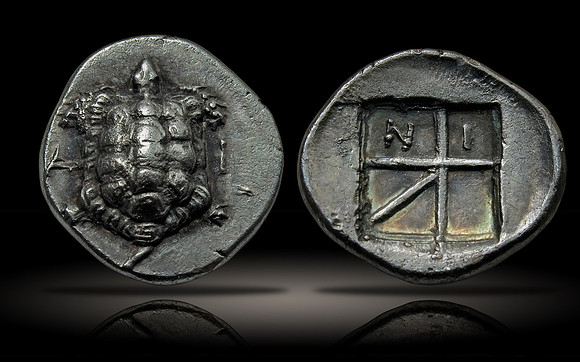
This coin is an obol from Aegina, depicting a land turtle as on their larger stater coinage. It is not known whether or not this coin was once used as a “Charon’s obol” but its pristine preservation over the millennia shows that it did not see much circulation or storage in adverse conditions.
Attic, Aegina; Obol, 0.91g. Milbank-pl. 3, 9 (same dies). Obv: Land turtle with segmented shell, A in field l. Rx: Four-part incuse, one quadrant divided by diagonal line; N I in two sections. Choice EF struck in high relief