Coinage of the Olympics
One of the few ancient traditions to survive until the modern world is the Olympics. Occurring in the same four-year cycle today as in antiquity, they mark a time when differences are put aside and the world’s attention focuses on athletic competition between nations.
The name “Olympics” originates from where they were played. Olympia was a sanctuary of ancient Greece near the city of Elis, a fertile country in the northwest of the Peloponnese. It featured temples, sporting grounds, and accommodations for the athletes. The inhabitants of Elis were responsible for organizing the games every four years. The stadium at Olympia seated no less than forty-five thousand, and the publicity for the winners was immense.
These games were some of the most significant events of antiquity, even causing wars to be suspended for their duration. The classical Olympics date back to at least 776 BC and were played until 394 AD when emperor Theodosius I abolished them, considering them to be too reminiscent of paganism. The modern games that began in Athens in 1896 featured 43 different events, steadily increasing to nearly 400 events today.
The ancient Olympics represented much more than just sporting events. They were a lucrative business and provided a political and cultural forum, offering a range of activities during the games. The athletes, their trainers, and the spectators needed to be housed, fed, and supplied with souvenirs. The games brought thousands of citizens together from all parts of the Greek world to visit the vast market and fairs, watch performances, and attend concerts.
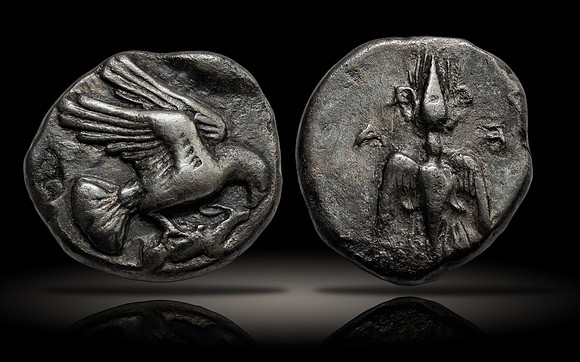
From the 5th to the 3rd century BC, a magnificent series of special silver coins were minted from the festival center for each iteration of the Olympic Games, with new designs produced every four years.
The coinage for the games served several purposes. No foreign money was accepted in Elis during the games, and the mandatory exchange offered means of funding the games and for the upkeep of the sanctuary at Olympia. A common currency also made commerce easier as the native currencies of the various visitors were often based on different weight standards.
The obverse of this particular coin contains a countermark of an owl, indicating that it circulated even farther after the attendee returned home, perhaps because of a need to use the funds from their souvenir.
Elis, Olympia, 87th-90th Olympiad, 432-420 BC. AR Stater (23mm, 11.51g, 9h). Eagle flying right with wings above his body, grasping hare by the back with his talons and tearing at him with his beak. Rev. F Thunderbolt with wings below and palmette with volutes above. BCD Olympia 53 var. Seltman 131 (BK/?d. SNG Cop 364 (= Seltman 131b). Rare. VF