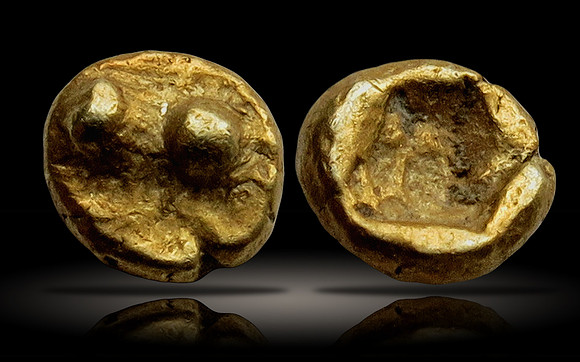
1/96th Stater
Despite hundreds of years of dedicated study by monks, academic researchers, and numismatists, much of ancient electrum is still poorly understood. The mint of this particular coin cannot currently be narrowed with any more precision than just originating from Ionia, a costal strip comprising the land near the mouth of the river Hermus to the river Meander, including the islands of Chios and Samos.
Ionia is believed to have been founded by colonists from Athens around 1000 BC. While in geographic proximity, the cities within Ionia, including Miletus, Phocaea, and Ephesus, issued substantially different coinage, delineated by representative seals of each city. This coin, however, has an obverse simply depicting two pellets, not matching any of the dedicated seals. Alternatively, some speculate that these represent the body of a bee, rendered abstractly due to limited space.
As in most electrum coinage, the reverse of this coin is produced by an incuse punch, which served to expose the interior of the coin (to instill confidence in its authenticity) and to allow metal to flow into the obverse die.
Uncertain Ionia; 650-600 BC, 1/96 Stater, 0.17g. SNG Kayhan-691 (1/192, one pellet). Obv: Two pellets. Rx: rough incuse square.
Ex. Gemini XII, 11 January 2015, lot 149.
Ex. "A South German Specialized Collection", Münzen & Medaillen Deutschland GmbH Auction 10, lot 47 (2002)
Ex. H.D. Rauch, Wien 53 (1994), 71.