The Most Prosperous Greek City in Italy
The mythology of Taras tells of how the original founder was miraculously saved from shipwreck by the intervention of his father, Poseidon, who sent a dolphin to his rescue. He was carried to the shore and, being so invigorated, he founded the city of Tarentum on the site.
Historically, Tarentum was founded in 708 BC by Partheniae, the free sons of unmarried Spartan women, on a small peninsula at the entrance of an inlet to the Mediterranean Sea. This position allowed them to command both the outer bay into which flowed the river Taras, and the inner port known today as the Mare Piccolo.
This offered significant strategic advantages to Tarentum. The land proved to be great for pastures, and the colonists were able to produce excellent wool and a breed of fine horses. There are also a variety of unique types of shell fish present in the small land-locked sea which have made the colony’s fishermen successful even into modern times.
Their harbor was the safest and most spacious on their coast, bringing them into commercial relations with all parts of the Mediterranean Sea.
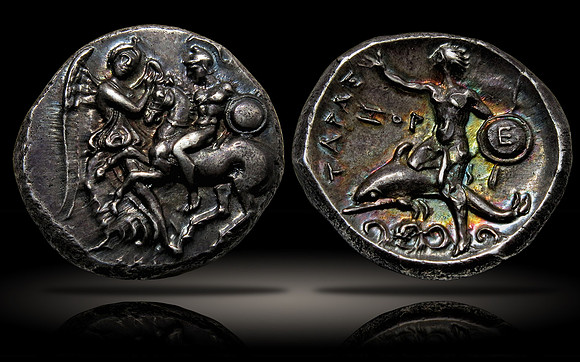
Tarentum consistently depicted Taras riding a dolphin on their coinage, acting as a civic badge. Aristotle even remarked upon this prominent attribute of the coinage in his work describing the structure of the Tarentine government.
While the general type remains fairly consistent, a substantial number of varieties were issued on the theme. The type on this particular coin is filled with political imagery during a heated period of Tarentum’s history.
This obverse type is a revival and artistic improvement upon a design which was briefly used during the first Lucanian War. It was selected again at the outbreak of new hostilities with the Lucani, likely motivated by a desire to introduce the theme of victory prominently into the coinage while still retaining the traditional types.
The reverse is remarkable for its significant departure from the general styles. It depicts an energetic scene of Taras rising to his full height with one knee on the dolphin’s back. Rather than leaning back in a relaxed position as in most of the other varieties, he displays strength and vigorously gestures for the city to follow him into battle.
The E inscribed on his shield also recalls the inscription on a shield of an armed horseman used on a coin of the earlier Pyrrhic period, likely referencing a historic warrior.
Ultimately, Tarentum fell to Rome but was allowed to continue minting their coinage and retain their Greek customs as a "civitas foederata”.
CALABRIA, Tarentum. Circa 302-280 BC BC. AR Nomos (21mm, 7.91 g, 6h). Warrior, nude but for crested helmet, wearing shield on left arm and holding spear in left hand, on horse prancing left; to left, Nike standing facing, restraining horse with both hands; [λYKIσKOσ below] / Phalanthos, nude, extending his right arm, wearing shield inscribed E on his left arm and holding two spears in his left hand, astride dolphin right; TAPAσ and ZOP to left, waves below. Vlasto 680 (same dies); HN Italy 963; SNG München 659; SNG ANS 1056-8; SNG Lloyd 197; SNG France 1874-6; Pozzi 357-8. Choice EF, lovely old cabinet tone. Charming composition, very well centered and struck for issue.
Ex Numismatica Genevensis V (2 December 2008), lot 19; Tkalec (19 February 2001), lot 3.