The First Circulating Coinage
Little is known about this mysterious archaic electrum coinage. It was minted in Ionia, somewhere in central Western Anatolia on the shores of the Aegean sea, but scholars have yet to identify the precise city-state that produced this sophisticated and attractive early type. Based on the weight of these coins, it is speculated that they could have been minted in Miletus, a city often referred to as the origin of the modern world, as it preceded Athens as the intellectual and commercial center of Greece.
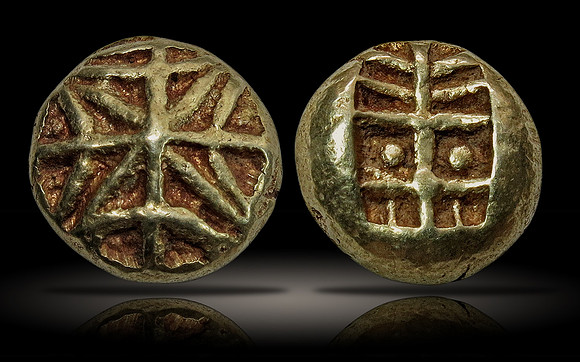
Both the obverse and reverse show well-executed geometric and linear images, with the obverse resembling a star (sometimes described as a "collapsing square"). The design is deliberate, and elements of it are repeated across each denomination, but the significance is unclear.
This type likely represents the first true coins which circulated in everyday use. The striation types are known to have been struck earlier but they are not found in heavily worn, circulated condition like many examples of this geometric coinage. It is also generally attributed as being the first coin made with an obverse and reverse type, as opposed to a simple incuse reverse.
The known populations of this type are primarily composed of small 1/24th staters which represented about a day’s pay. Larger denominations are quite rare, including this hekte (one-sixth stater). Even fewer trites (one-third stater) are known and only three full-size staters have been found.
While the stater and trite have different obverse and reverse types, the hektes combine the obverse of the stater with the reverse of the trite, which could have been used to differentiate value.
IONIA, Uncertain. Circa 650-600 BC. EL Hekte – Sixth Stater (9mm, 2.30 g). Lydo-Milesian standard. Geometric type. Geometric figure resembling a star, composed of a cross centered upon a polygon of eight sides within a square with slightly rounded sides / Rectangular incuse punch divided horizontally and vertically into four compartments by two perpendicular lines; the upper two compartments divided into thirds by two parallel lines; the lower two compartments divided into halves by a single line, the upper halves contain a pellet, the lower halves are bisected by two small vertical lines. McFaddden 2; Weidauer –; Traité I 5; SNG Kayhan 698; Boston MFA –; Rosen –; Elektron –; Zhuyuetang 3 (all from same die and punch). EF, lightly toned. Well centered. From the Lexington Collection.