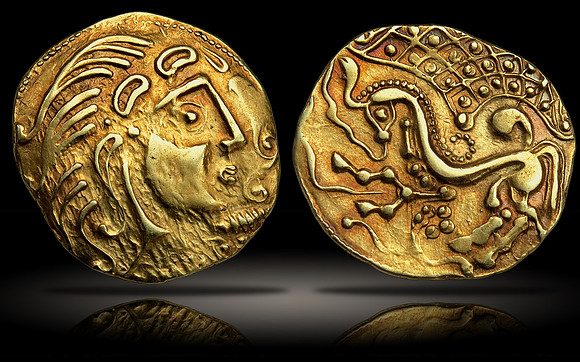
Parisii Stater
The Celtic tribe of the Parisii, whose capital was Lutetia on the Seine, played a significant role in the Gallic Wars. Lutetia, located on what is now the Île de la Cité in modern Paris, was a marshy settlement prone to flooding. The Parisii grew wealthy as middlemen in the tin trade with Britain. During Caesar’s campaign in 52 BCE, the Parisii burned their city and bridges to hinder the Roman advance, but Lutetia was later rebuilt under Roman rule and renamed Parisii, eventually evolving into Paris.
The Parisii were notable for their exceptional gold staters, considered masterpieces of Gallic coinage. Inspired by Philip II of Macedon’s coins, their designs were uniquely transformed by Celtic artistry. The obverse features a cubist-like Apollo, while the reverse depicts a richly detailed horse beneath a triangular, wing-like motif, possibly symbolizing the heavens. These coins, struck during Caesar’s invasion of Gaul, reflect the artistic ingenuity and wealth of the Parisii.
Once dismissed as "barbaric," Celtic coinage gained appreciation in the 20th century for its imaginative and rule-defying designs. The Parisii staters, first attributed to them by numismatist A. Duchalais in 1846, are now celebrated as the pinnacle of Celtic monetary art, combining elements of classical prototypes with distinctive Celtic motifs. Their quality and craftsmanship underscore the Parisii's significance in Gallic history.
GALLIA. PARISII. Stater, gold, class V, about 100-50 BC. AV 7.06 g. Head with flowing locks r., in front, large double volute, below, pine cone (or club ?); below truncation, vertical lines. Rev. Bridled horse galloping l., above, aegis-shaped net; between legs, dotted rosette. DT I, 42,83. J.-B. Colbert de Beaulieu, Les monnaies gauloises des Parisii (1970), cl. V/ fig. 15,2.
Ex. F.R. Künker GmbH & Co. KG, Osnabrück 270 (2015), 8006.