Sulla's Occupation of Athens
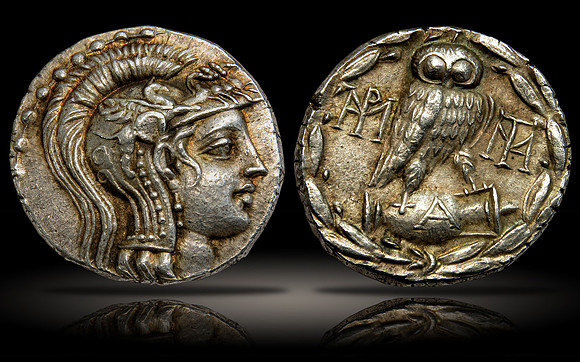
The Athenian coinage struck during 87/6-84 BC is historically significant, marking the last "ancient" silver coins produced in Athens and directly linked to the events of the First Mithridatic War. During this period, the Roman consul Sulla invaded Greece to combat Mithradates VI, the Pontic king who had recently seized the region. Sulla's coinage in Athens, primarily composed of silver tetradrachms and a smaller number of silver drachms, was distinct from earlier Athenian coinage. While it retained the basic designs of the Athenian 'New Style' tetradrachms, the familiar wreath design was simplified, and the reverse fields were often marked by monograms or trophies rather than the elaborate symbols and inscriptions of previous coins. These coins, which are mentioned in ancient literature, reflect the transitional nature of the period and the direct influence of Roman military and political power.
The Sullan coinage in Athens is notable for its clear connection to the Roman military occupation of the city. Following his landing in Greece in 87 BC, Sulla faced the challenge of financing his campaign and supporting his army. The monogram coins, likely issued after Sulla's conquest of Athens in 86 BC, are believed to have been minted to fund the siege and supply Roman troops. These coins were potentially struck outside of Athens, leading some to classify them as 'pseudo-Athenian.' In addition to their historical context, the coins also carry a connection to the figure of L. Licinius Lucullus, Sulla’s proquaestor, who was credited with overseeing the coinage during this campaign. The coins became widely circulated, and the term “Lucullan” was coined in reference to them, further highlighting their significance and rapid distribution.
Sulla's occupation of Athens during the First Mithridatic War was marked by strategic plundering of local shrines to support the Roman war effort. The coinage struck during this period was carefully designed to resemble familiar Athenian types, ensuring its acceptability across the region. The monogram on the reverse of some of the coins references Marcus Licinius Lucullus, the quaestor responsible for their production, while the simpler symbols, such as trophies, signify a shift in the style and function of the coinage. These coins are thought to have been struck shortly before Sulla departed for Rome, with later issues omitting the letter "A" on the amphora. The historical and numismatic evidence from this period underscores the unique role of coinage in supporting military operations and influencing local economies during times of war.
ROMAN PROVINCIAL COINS. PELOPONNESUS. SULLA, 138-78 BC. Tetradrachmon ("Leukolleion"), in the manner of Athens (NS), struck in an uncertain mint, about 88-87 BC. AR 16.65 g. Head of Athena r., wearing triple crested Athenian helmet, decorated with Pegasus and four horses. Rev. Between two monograms, owl, head facing, standing r. on amphora inscribed with A; the whole within laurel wreath. Boehringer, CMM (1972 28-31 and pl. 29, 10; Thompson, NS 426, 1293.
Ex. J. Vinchon 27 February 1961, Lot 157, A. Trampitsch collection.; Auction J. Vinchon, Paris 13 & 14 November 1986 (Monte-Carlo), 183.