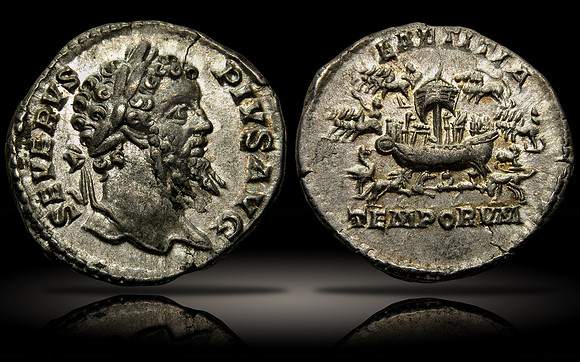
A Celebration at the Circus Maximus
Following Septimius Severus’ victories in the East, elaborate seven-day celebrations were staged in the Circus Maximus to commemorate both military success and imperial legitimacy. Central to these spectacles was a large ship-like structure erected within the arena, from which exotic animals were released in dramatic displays. Contemporary and later accounts describe hundreds of wild and domesticated beasts emerging simultaneously before being hunted and slaughtered. The coin reverse associated with these festivities presents a condensed visual representation of the events, depicting chariot races in the upper register, the ship at the center, and wild animal combats below.
The celebrations of AD 206 consciously replicated those held in AD 202 following the imperial family’s return from successful eastern campaigns. The complex iconography of the coinage reflects the diverse entertainments offered during these games, including chariot racing, staged combats involving exotic animals, and naumachiae, or mock naval battles. Literary evidence from Cassius Dio describes a ship-shaped structure capable of containing hundreds of animals, which were released when the construction collapsed. Details on the coin, such as the depiction of a long-necked bird identified variously as an ostrich or crane, further emphasize the exotic and theatrical character of the spectacles.
More broadly, these celebrations formed part of Severus’ effort to associate his reign with that of Augustus. The coin type has been linked to the Ludi Saeculares of AD 204, which were deliberately celebrated according to the Augustan cycle, 220 years after the games of 17 BC. By invoking Augustan precedents through public games, donatives, gladiatorial contests, and ceremonial displays, Severus sought to present himself as a “second Augustus” and the inaugurator of a renewed Golden Age. Surviving literary fragments and contemporary interpretations suggest that these events promoted the notion that Severus’ rule marked the beginning of a prosperous and harmonious era, expressed in the phrase laetitia temporum (“the happiness of the age”).
ex Palombo 17, 20 October 2018, 84 and Aureo & Calicó 300, 9 November 2017, 125, from the Imagines Imperatorum Collection, Aureo & Calicó, 15 February 2012, 146, ex Sotheby's Zürich, 28 October 1993, 1627 and Tkalec, 23 October 1992, 298.