The Gonzaga Collection
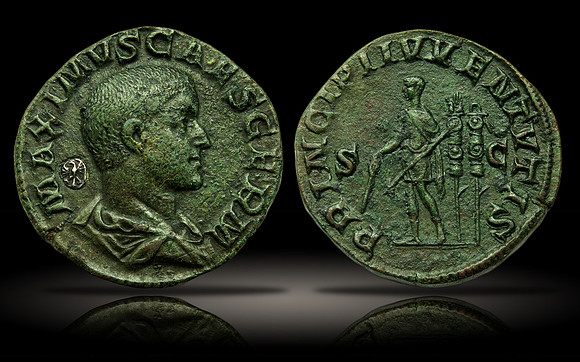
For centuries, numismatists and scholars have debated the origins of the distinctive eagle collector's mark, found on the obverse of a select number of predominantly Greek and Roman coins. The attribution of this mark has been contested between two prominent Italian noble families: the Gonzagas, rulers of Mantua, the proclaimed birthplace of the poet Virgil, and the Este family of Ferrara, whose lineage traces back to the 10th century. The confusion largely arises from the intermingling of the two families’ collections during the 17th century. During the War of the Mantuan Succession (1628–1631), Duke Charles II Gonzaga of Nevers used the Gonzaga coin collection as collateral. In the turmoil of late Renaissance Italy, the Este family acquired the Gonzaga collection, which the Gonzagas were ultimately unable to reclaim.
The Este family’s coin collection, initially established by Leonello d’Este (1407–1450), Marquis of Ferrara, grew into a remarkable multigenerational legacy. Leonello began acquiring primarily bronze coins before 1430, laying the foundation for what would become one of Italy’s most esteemed collections. His half-brother, Ercole I d’Este (1431–1505), Duke of Ferrara, expanded the collection significantly, owning 437 gold coins by 1494, including pieces acquired from the papal collection of Pope Paul II. Ercole's son, Alfonso I d’Este (1505–1534), further enriched the collection with the assistance of renowned artist Raphael, who sought out "antique medals, heads, and figures" on Alfonso’s behalf. Under Ercole II d’Este (1508–1559), Duke of Ferrara, the family cataloged their growing collection between 1538 and 1541, solidifying its place as a symbol of Renaissance art and culture.
The Este family’s coin collection reached its pinnacle under Alfonso II d’Este (1533–1597), Duke of Ferrara from 1559 to 1597. Some gold coins featuring the distinctive eagle inset are documented in the 1541 manuscript of the collection. However, the absence of certain coins now bearing the eagle inset suggests that the mark was applied after this date. Further evidence comes from Enea Vico (1523–1567), who oversaw acquisitions for the Este family and referenced the collection in a 1563 writing that does not mention the inset. This points to a slightly later period for the application of the eagle mark.
A likely catalyst for the application of the eagle inset was an exhibition organized by the renowned artist and architect Pirro Ligorio (c.1510–1583). Ligorio, known for his significant manuscripts, worked under the patronage of the Este family in Ferrara between 1568 and 1574. During this time, he managed and curated the duke’s collections in the Antichario, compiling many of his well-known works. In addition to his contributions to the Este collection, Ligorio served as the Vatican’s Papal Architect under Popes Paul IV and Pius IV, further highlighting his prominence in the artistic and architectural landscape of the Renaissance.
Based on available evidence, scholars have concluded that the eagle inset was a hallmark of the Este family collection, likely applied between 1563 and 1614. This timeframe aligns with the tenure of Pirro Ligorio, who managed the Este collections between 1568 and 1574. In 1647, the Este family recovered 710 pawned aurei featuring the eagle inset. Out of the original 12,000–15,000 coins in the collection, only approximately 1,500 were marked with the inset, which was applied to coins in silver or gold. Bronze coins are notably rarer and less frequently found with the eagle mark.
Over time, portions of the Este collection were dispersed to museums and private collections, with significant holdings ending up in Milan, Modena, Paris, and even the personal cabinet of Roman coins owned by Queen Christina of Sweden (1626–1689). Coins bearing the eagle inset now appear irregularly on the market, making them highly sought after by collectors, as an artifact from a verified and prestigious 15th-century collection.
Maximinus I Thrax, 235-238. - for Maximus. Æ-Sestertius, 236/238, Rome; 18.96 g. Draped bust right; in the field left. Collector's mark of the Gonzaga family: Eagle facing front, silver-plated//Prince standing left with staff and spear, behind two standards. BMC 213; Coh. 14; RIC 13.
Ex. Gonzaga collection; Collection of an Amateur of New York, J. Schulman, 21-22 October 1934 lot 52i; Ex. HC Levis Collection, Ars Classica Auction 11 lot 831, June 18, 1925; Privately acquired in 1995