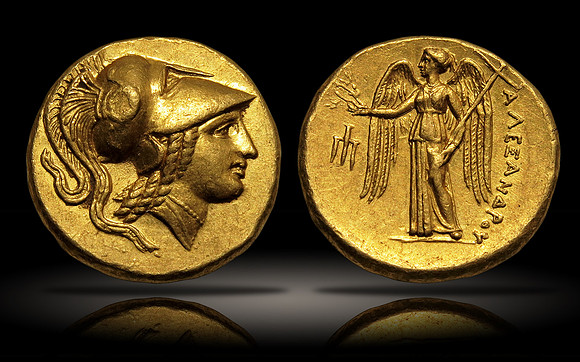
Nike, the Goddess of Victory
Alexander the Great’s conquests provided him with a substantial quantity of gold from which to mint the defining coinage of the world. The majority of these coins were minted in the denomination of a stater, represented by 349 known varieties. The larger distater is considerably rarer, with only 11 varieties known. The stater’s broad mintage meant it needed to be designed and engraved by a number of different artists of varying style and ability, although the primary details remained consistent.
The obverse depicts Athena wearing a Corinthian helmet pushed backward, with her hair showing through the top of the eye holes. This differs from how the helmet would have been worn in battle but it follows the style established by the Athens “owl” tetradrachms where the eyes remain visible.
The reverse depicts the goddess Nike wearing a headband and tunic, holding a laurel wreath in her left hand and part of the stern of a Greek ship in her right. These implements reference symbols of victory and allude to Greece’s defeat of Persia at the Battle of Salamis in 480 BC, one of the turning points of Western civilization.
On this particular coin, one can appreciate the skill of the die engraver, especially on the reverse. The highly artistic depiction of Nike shows charm in a delicate style, unlike most of Alexander’s staters. Nike’s face and wings are depicted with significant detail and expression, making this one of the most attractive pairs of dies produced for the series.
Kingdom of Macedon, Alexander III 'the Great' AV Stater. Amphipolis, circa 325-319 BC. Head of Athena to right, wearing triple crested Corinthian helmet, decorated with coiled serpent / Nike standing left, holding wreath and stylis, trident head downward in left field; ΑΛΕΞΑΝΔΡOΥ to right. Price 172b-d; SNG Saroglos 103. 8.62g, 18mm, 3h. Good Extremely Fine. Exceptionally well detailed and of wonderfully delicate style.