Animals on Coinage
Animals are frequently featured on electrum coins, ranging from abstract representations to realistic depictions. These animals were often chosen to represent species of religious and sacrificial importance or as the focal animals for the reigning gods of the region. The physical attributes of particular animals were also selected for propaganda purposes, equating the strength and power of the animal with that of the city-state to elevate its status in the eyes of those who used the coins.
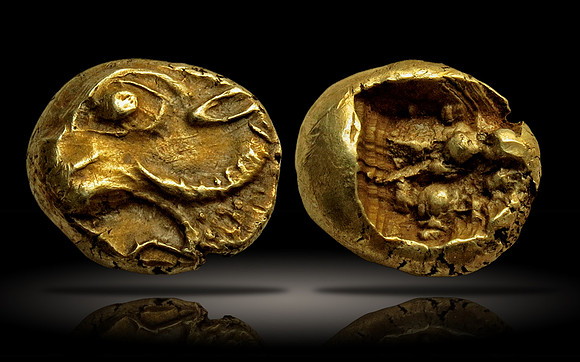
This coin is an extremely rare 1/12th early archaic stater and while it’s not certain precisely where this coin was struck, Agnes Baldwin Brett proposed that it was struck in Clazomenai because the ram was commonly used as a coin design of this city during the fourth century BC.
Ram’s heads were popular in Greek artwork, especially bronze sculptures. While the attribution isn’t certain, it’s possible that the ram on this coin represents the ram-god Apollo Carneius, a seer and son of Zeus and Europe.
This coin comes from a long pedigree, being pictured in the de-facto reference for electrum coinage by Dr. Liselotte Weidauer and in “Electrum and the Invention of Coinage” by Joseph Linzalone. It also resided in the famous collection of Hans von Aulock.
Von Aulock (1906-1980) was the son of Major John von Aulock of Silesian nobility. He held numerous positions at international banks, eventually becoming a consultant at a Turkish bank. It was during his time in Turkey that von Aulock developed his interest in ancient coins. He built an extensive collection focused around Asia Minor coins of the Roman Empire. His collection was published in eighteen volumes of the Sylloge Nummorum Graecorum series and remains one of the most important reference works for Greek coins of the Roman Empire. He was given an honorary doctorate for this work and upon his death his collection was dispersed, with much of it being sold to the British Museum in London.
Ionia, Hemihekte. Ram's head left. Rv: Square punch with irregular surface. (1.14g, 8.5mm) Weidauer 51 (this coin), SNG Von Auloch 1798 (this coin), Ln 1135 (this coin).