The Three-Month Reign of Otho
The year 69 AD was a tumultuous time for Rome, seeing the brief reigns of four emperors and the start of a civil war following the suicide of Nero. Each of these leaders had larger-than-life personalities, reflected in their portraits on coins and colorful historical accounts. The short terms of these emperors made all of their coinage rare.
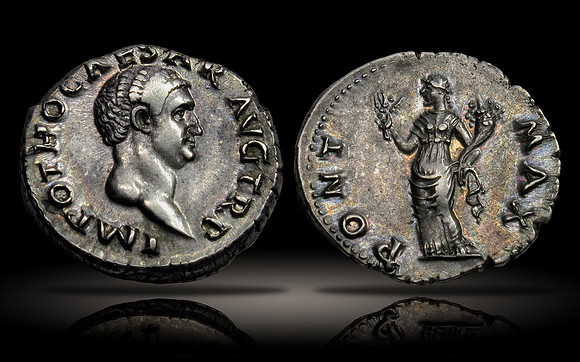
Marcus Salvius Otho was born in 32 AD to a wealthy family where he was heavily pampered and developed many abnormal traits. He disliked hair and had all of his body and head hair removed. He then wore a carefully made wig to cover his baldness, clearly visible in the outstanding portrait on this coin.
Otho was a companion of Nero’s until 58 AD when Nero began courting Otho’s wife. Nero appointed Otho governor of Lusitania and then married his wife while he was away. Infuriated, he joined the revolt being run by Galba as one of his earliest supporters. At 70 years old, Galba became emperor and Otho expected to be named his successor. However, Galba chose a young aristocrat, and Otho retaliated by immediately beginning to plot his assassination.
He put himself substantially in debt to accumulate enough funds to bribe the Praetorian Guard to murder Galba. After Galba’s death, the terrified Senate quickly appointed Otho emperor, making Otho the first to become emperor by publicly murdering his predescessor.
Otho minted this coin early in his reign, after claiming himself to be the “High Priest” (Chief Pontif) of Rome, as indicated in the reverse inscription of “PONT MAX” (Pontifex Maximus).
Otho’s reign would be brief, as Vitellius’ army was quickly marching toward Italy. Otho and the Praetorian Guard attempted to hold the line against Vitellius at the River Po in Cremona, but the battle went decisively against Otho, and 40,000 soldiers died.
His generals wanted to keep fighting, but Otho decided to spare Rome further bloodshed. As a final feat of nobility, he committed suicide on April 17th, 69 AD, gaining him a modicum of respect in death despite his many poor decisions in life.
BNF III 25; RSC II 11; BMCRE I 9 (BM specimen condemned as a modern forgery); RIC I -; SRCV I -, Attractive portrait, Superb EF, light toning on luster, good strike with fresh dies but very highest points a little weak, Rome mint, weight 3.614g, maximum diameter 19.7mm, die axis 180o, 9 March - 17 April 69 A.D.; obverse IMP OTHO CAESAR AVG TR P, bare head right; reverse PONT MAX, Ceres standing left, grain-ears in right, cornucopia in left; from the Jyrki Muona collection; rare;